
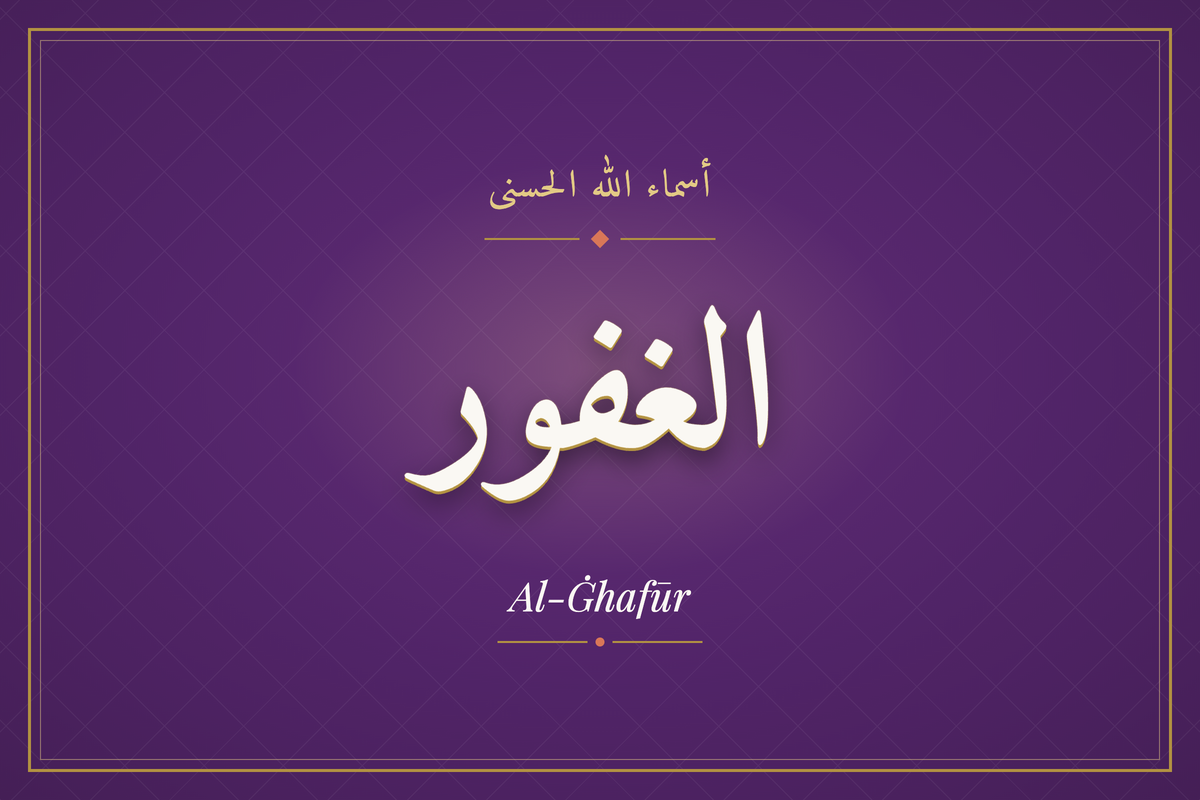
Al-Ghafūr (الغَفُور), "The Most Forgiving," is one of the most repeated Names of Allah in the Quran — and one of those most needed by the believer. It designates the One who covers faults, erases them and holds no grudge against them, however great they may be. Whatever fault weighs upon your heart, it remains smaller than the forgiveness of Al-Ghafūr.
What does Al-Ghafūr mean?
The name Al-Ghafūr comes from the Arabic root ghayn-fā'-rā' (غ ف ر), whose primary meaning is "to cover, to veil" — like the mighfar, the helmet that covers the warrior's head. Applied to Allah, this Name designates:
- He who covers the fault: He does not expose the sinner before the creation and preserves his honor, in this life as in the Hereafter.
- He who effaces the fault: divine forgiveness does not merely hide, it erases the trace of sin and its punishment.
- He whose forgiveness is immense: the intensive form Ghafūr indicates a forgiveness that reaches the greatest sins, never becoming depleted.
Al-Ghafūr in the Quran
The most comforting verse of the Quran proclaims:
قُلْ يَا عِبَادِيَ الَّذِينَ أَسْرَفُوا عَلَىٰ أَنفُسِهِمْ لَا تَقْنَطُوا مِن رَّحْمَةِ اللَّهِ ۚ إِنَّ اللَّهَ يَغْفِرُ الذُّنُوبَ جَمِيعًا ۚ إِنَّهُ هُوَ الْغَفُورُ الرَّحِيمُ
"Say: O My servants who have committed excesses against yourselves, do not despair of Allah's mercy. Indeed, Allah pardons all sins. Yes, He is the Pardoner, the Most Merciful." (Surah Az-Zumar, 39:53)
And Allah also says:
نَبِّئْ عِبَادِي أَنِّي أَنَا الْغَفُورُ الرَّحِيمُ
"Inform My servants that I am the Pardoner, the Most Merciful." (Surah Al-Hijr, 15:49)
In the Quran, Ghafūr is very often associated with Rahīm (Most Merciful): forgiveness is never a cold cancellation of debt, but rather the expression of a merciful love that welcomes those who return.
The Sacred Hadith of Hope
In a hadith qudsi, Allah says: "O son of Adam, as long as you call upon Me and hope in Me, I will forgive you for what you have done, without concern. O son of Adam, if your sins reached the clouds of the sky and you asked Me for forgiveness, I would forgive you." (reported by At-Tirmidhī)
No past disqualifies the servant who turns to Al-Ghafūr: the only sin without remedy is the one from which one refuses to return.

Living with Al-Ghafūr Daily
1. Never despair, never trivialize
Faith in Al-Ghafūr stands between two extremes: despair ("my sin is too great") and heedlessness ("I will sin, He will forgive"). The believer sins, regrets, returns — and continues on the path without dragging their sin like a chain.
2. Make istighfār a breath
The Prophet ﷺ asked forgiveness from Allah more than seventy times a day (Al-Bukhārī) — he to whom all was forgiven. Astaghfirullāh on the tongue, at work, in the car, after prayer: it is the daily maintenance of the heart.
3. Forgive to be forgiven
Allah says: "Let them pardon and overlook. Do you not like that Allah should forgive you?" (Surah An-Nūr, 24:22). Covering the faults of others, renouncing resentment: this is treating the creation as one hopes to be treated by the Creator.
Invocation with the name Al-Ghafūr
The most complete request for forgiveness is the sayyid al-istighfār, taught by the Prophet ﷺ : اللَّهُمَّ أَنْتَ رَبِّي لَا إِلَهَ إِلَّا أَنْتَ، خَلَقْتَنِي وَأَنَا عَبْدُكَ، وَأَنَا عَلَى عَهْدِكَ وَوَعْدِكَ مَا اسْتَطَعْتُ، أَعُوذُ بِكَ مِنْ شَرِّ مَا صَنَعْتُ، أَبُوءُ لَكَ بِنِعْمَتِكَ عَلَيَّ وَأَبُوءُ بِذَنْبِي فَاغْفِرْ لِي، فَإِنَّهُ لَا يَغْفِرُ الذُّنُوبَ إِلَّا أَنْتَ
"O Allah, You are my Lord, there is no deity except You. You have created me and I am Your servant… I acknowledge Your favor upon me and I acknowledge my sin: forgive me, for none forgives sins except You." (Al-Bukhārī)

Frequently Asked Questions About Al-Ghafūr
What is the difference between Al-Ghafūr and Al-Ghaffār?
Both derive from the same root. Al-Ghaffār emphasizes repetition: He forgives again and again, as many times as the servant returns. Al-Ghafūr emphasizes vastness: His forgiveness reaches even the greatest sins. Repetition and immensity — divine forgiveness has no limit neither in number nor in size.
Does Allah truly forgive all sins?
For the one who repents before death, yes — this is the meaning of verse 39:53. For the one who dies without repentance, Allah says He does not forgive associating partners with Him, but forgives what is beneath that to whom He wills (Surah An-Nisā', 4:48). The door of repentance, however, remains open throughout life.
What are the conditions of sincere repentance?
Scholars mention three: ceasing the sin, regretting it sincerely, and having the firm resolve not to return to it — and a fourth if the sin has wronged another: to make amends or seek forgiveness. All of it sealed by hope in Al-Ghafūr, never by despair.
📚 Continue your reading of the 99 Names
−5% off the entire library with code BLOG5
Valid throughout the site, with no minimum purchase — our thanks to our blog readers.
Discover our books on the Names of Allah


