
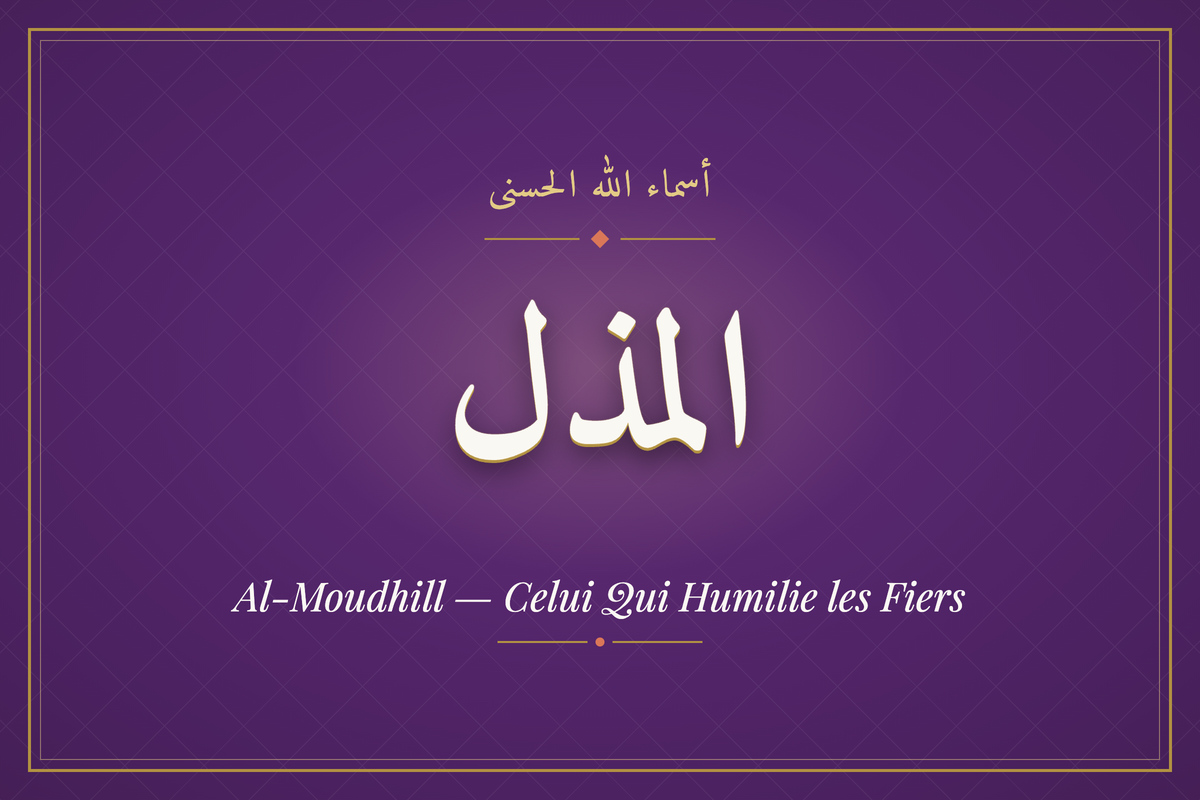
Al-Moudhill (المُذِلّ), "The One Who Humiliates," is one of Allah's Names that tradition cites alongside its counterpart: Al-Mu'izz, "The One Who Grants Might." It designates the One who abases the arrogant, strips tyrants of their pride, and makes those who defy their Creator taste humiliation. For the oppressed, this Name is a promise; for the proud, a solemn warning.
What does Al-Moudhill mean?
The name Al-Moudhill comes from the Arabic root dhāl-lām-lām (ذ ل ل), which expresses lowliness, submission and humiliation. Applied to Allah, this Name designates:
- The One who humiliates the arrogant: whoever takes pride against Allah and His creatures will be stripped of their vanity — Iblis was the first example of this.
- The One who debases the enemies of truth: the tyrants who fight against the religion of Allah end up in abasement, no matter how great their apparent power.
- The One whose humiliation is justice: Allah never humiliates on a whim — His abasement is the exact retribution for pride and injustice.
Al-Moudhill in the Quran
Allah says:
وَتُعِزُّ مَن تَشَاءُ وَتُذِلُّ مَن تَشَاءُ ۖ بِيَدِكَ الْخَيْرُ
« You give power to whom You will and You humble whom You will. The good is in Your hand. » (Surah Āl 'Imrān, 3:26)
And regarding those who oppose Allah:
« Those who oppose Allah and His Messenger, those will be among the most humiliated. » (Surah Al-Mujādala, 58:20)
The Quranic story gives the supreme example: Pharaoh, who proclaimed himself divine and oppressed the Children of Israel, was drowned in the sea — his body preserved as a sign for generations (Surah Yūnus, 10:90-92). Notice the subtlety of verse 3:26: after mentioning power and humiliation, Allah says « the good is in Your hand » — for even the abasement of tyrants is good: it frees the oppressed and restores justice.

Living with Al-Mudhill in Daily Life
1. Fear Pride More Than Failure
The Prophet ﷺ said: "He will not enter Paradise who has in his heart the weight of a grain of mustard seed of pride," and he clarified: "Pride is to reject the truth and despise people." (reported by Muslim). Failure does not distance one from Allah — pride does.
2. Do Not Humiliate Yourself Through Sin
The scholars teach that disobedience carries within it its own humiliation: the sinner feels in his heart a baseness that wealth cannot compensate for. Conversely, obedience adorns with honor — it is before Allah alone that one lowers oneself to be elevated.
3. Be Patient Before Unjust Oppressors
The oppressed believer does not respond to injustice with despair: he knows that the case is not closed. Al-Mudhill grants a reprieve, never forgetfulness — and on the Day when "it will abase some and exalt others" (56:3), every arrogance will be held accountable.
Invocation with the Name Al-Moudhill
Allah says: "To Allah belong the most beautiful Names. Invoke Him by these Names" (7:180). The believer invokes this Name against injustice — never out of personal vengeance, but for the triumph of justice: يَا مُذِلِّ كُلِّ جَبَّارٍ عَنِيدٍ اكْفِنِي شَرَّ الظَّالِمِينَ
"O You who humiliate every stubborn tyrant, protect me from the evil of the unjust." And he asks for himself protection against pride, the cause of all humiliation.

Frequently Asked Questions about Al-Moudhill
How can a Name of humiliation be a "beautiful Name"?
Because the humiliation of tyrants is a mercy for their victims and perfect justice. Verse 3:26 seals it: "all good is in Your hand" — divine abasement is never cruelty, it is the restoration of just order.
What is the difference between Al-Moudhill and Al-Khāfid?
The two Names are close: Al-Khāfid lowers ranks and positions; Al-Moudhill touches dignity itself — it strips the arrogant of their pride and clothes them in disgrace. One brings down, the other removes usurped honor.
Can a believer be humiliated by Allah?
Trial is not humiliation: poverty or illness can elevate the believer. True humiliation is that of the heart far from Allah. The believer asks in his prayer to live and die in the dignity of faith — and Allah never abandons those who hold fast to Him.
📚 Continue reading the 99 Names
−5% off the entire library with code BLOG5
Valid on the entire site, no minimum purchase — our thanks to blog readers.
Discover our books on the Names of Allah


