
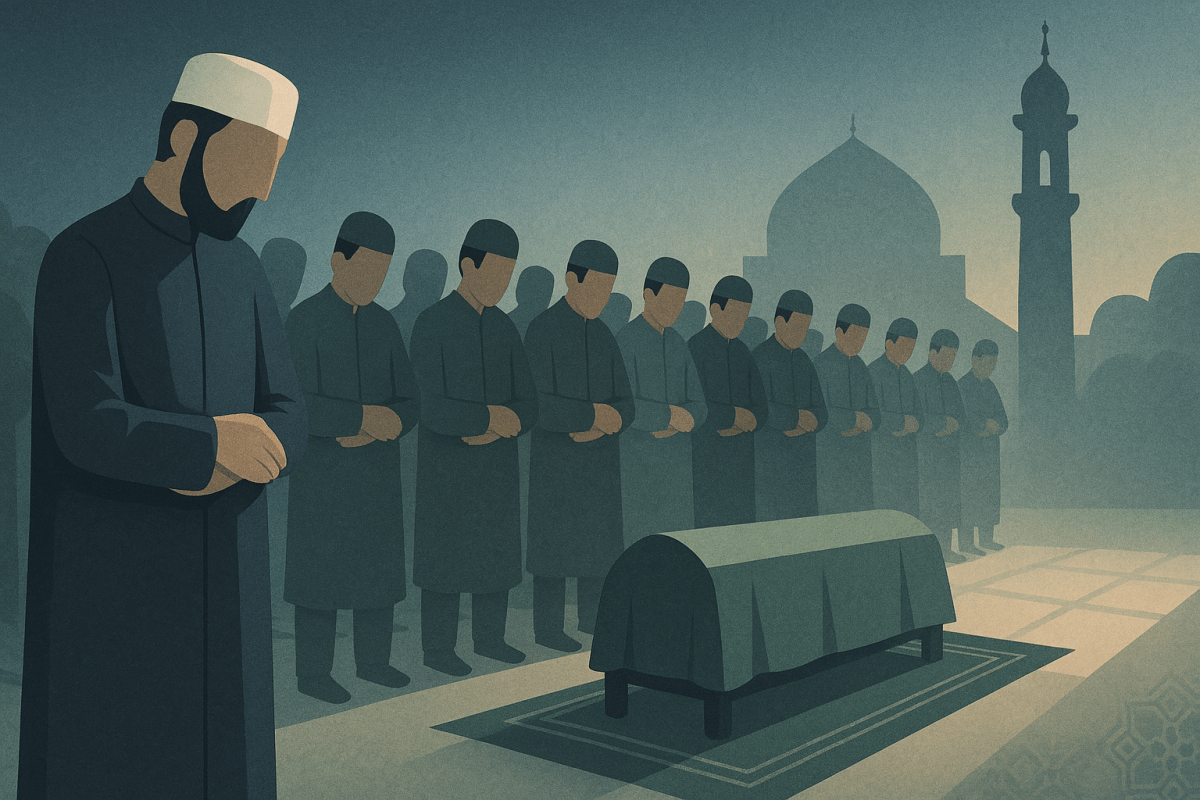
The Salat Janaza (صلاة الجنازة) represents one of the final tributes paid to a deceased Muslim and symbolizes the solidarity of the community (الأمة) toward the departed and their family. This funeral prayer distinguishes itself from other prayers by its unique form, without bowing (ركوع) or prostration (سجود), reflecting the solemnity of the moment and humility before the fate that awaits every human being.
This Islamic funeral ritual, at once simple in form and profound in meaning, reminds us of our own mortality and the importance of spiritual preparation. By praying collectively for the deceased, Muslims manifest their hope in divine mercy (الرحمة) and express their conviction that every soul returns to its Creator. The prayer for the deceased (الصلاة على الميت) thus becomes a moment of reflection, supplication, and spiritual connection for the entire community, recalling the Quranic verse: "Inna lillahi wa inna ilayhi raji'un" (إنا لله وإنا إليه راجعون) - "Indeed we belong to Allah, and indeed to Him we will return" (Al-Baqara, 156).
In Brief
The Salat Janaza (صلاة الجنازة) is a communal obligation (Fard Kifaya - فرض كفاية) composed of 4 Takbirs without bowing or prostration. After the 1st Takbir, Al-Fatiha is recited; after the 2nd, the prayer upon the Prophet ﷺ; after the 3rd, the supplication for the deceased; after the 4th, a brief supplication then the Taslim. The body must be previously washed (ghusl) and wrapped in a shroud (kafan). The higher the number of participants, the more the intercession on behalf of the deceased is considered to be effective.

Definition and Religious Status of Funeral Prayer
The Salat Janaza constitutes a collective duty (Fard Kifaya - فرض كفاية) in Islam, which means that if a sufficient number of Muslims perform it, the obligation is lifted for the rest of the community. Conversely, if no one performs it, the entire community bears the sin. This funeral prayer is obligatory for every deceased Muslim, whether they were practicing or not, because the right to this prayer is a fundamental right of the Muslim over their brothers and sisters in Islam.
The fundamental objective of this prayer is to beseech Allah for the forgiveness of the deceased's sins (المغفرة), His mercy (الرحمة), their admission to Paradise (الجنة) and the alleviation of their trial in the grave (عذاب القبر). The Prophet ﷺ said: "Pray over your dead" (Ibn Majah), emphasizing the importance of this act of spiritual solidarity.
Notable exceptions concern the martyrs (الشهداء) who fell in battle, for whom the funeral prayer is subject to disagreement among scholars, and non-pubescent children (الأطفال) for whom the prayer is performed with an appropriate supplication, as they are considered exempt from sins among the fundamental principles of faith.

Funeral Rites in Islam - Fiqh and Practice
Editions Tawhid
The reference work covering all Islamic funeral rites: ritual washing (ghusl), shroud (kafan), Salat Janaza, burial and supplications for the deceased. A comprehensive guide combining fiqh and practice to honor our deceased with dignity.
14,00 €
View the bookEssential Preparations Before Prayer
Before performing the Salat Janaza, several preliminary conditions must be observed:
Preparation of the Deceased
The body of the deceased must be ritually washed (ghusl al-mayyit - غسل الميت) according to Islamic prescriptions. This washing is performed by trustworthy persons, generally of the same gender as the deceased (except between spouses). The body is then wrapped in a white shroud (kafan - الكفن), preferably in three pieces of white cloth for a man and five for a woman. The shroud symbolizes the equality of all before death and the return to original simplicity.
Preparation of the Faithful
The participants must be in a state of ritual purity (wudhu - الوضوء), as for any prayer in Islam. They must dress modestly, in accordance with Islamic rules for covering the 'awra (العورة). The prayer is performed standing, facing the qibla (القبلة), with the body of the deceased placed in front of the imam.
Detailed Procedure of Salat Janaza
The Salat Janaza is distinguished from other prayers by its absence of bowing (ruku) and prostration (sujud). It comprises four Takbirs (تكبيرات) and takes place entirely while standing:
First Takbir (التكبيرة الأولى) : Raise the hands to ear level saying "Allahu Akbar" (الله أكبر), then place the hands on the chest. Recite Surah Al-Fatiha (الفاتحة) in a low voice. The Maliki school does not recite Al-Fatiha but begins directly with the supplication.
Second Takbir (التكبيرة الثانية) : Raise the hands again saying "Allahu Akbar". Recite the blessings upon the Prophet ﷺ (Salat Ibrahimiyya - الصلاة الإبراهيمية) : "Allahumma salli 'ala Muhammad wa 'ala ali Muhammad, kama sallayta 'ala Ibrahim..." (اللهم صلِّ على محمد وعلى آل محمد كما صليت على إبراهيم...).
Third Takbir (التكبيرة الثالثة) : Raise the hands saying "Allahu Akbar". Make the specific supplication for the deceased : "Allahumma ghfir li hayyina wa mayyitina, wa shahidina wa gha'ibina, wa saghirina wa kabirina, wa dhakarina wa unthana. Allahumma man ahyaytahu minna fa ahyihi 'ala al-islam, wa man tawaffaytahu minna fa tawaffahu 'ala al-iman" (اللهم اغفر لحيّنا وميّتنا وشاهدنا وغائبنا وصغيرنا وكبيرنا وذكرنا وأنثانا. اللهم من أحييته منا فأحيه على الإسلام ومن توفيته منا فتوفه على الإيمان). This supplication asks for forgiveness for the living and the dead, those present and absent, the young and the old.
Fourth Takbir (التكبيرة الرابعة) : Raise the hands saying "Allahu Akbar". Make a brief supplication, then conclude with the Taslim (التسليم) by turning the head to the right saying "As-salamu alaykum wa rahmatullah" (السلام عليكم ورحمة الله). According to some schools, a single Taslim to the right is sufficient.
Recommended Books on Funeral Rites
To master the rules and invocations of the Salat Janaza, here is a selection of specialized works available in our spirituality collection :

70 Questions on Funeral Rules
Clear answers from the great scholar Ibn Al-Uthaymine to the 70 most frequently asked questions about funeral rites. An accessible question-and-answer format that covers Salat Janaza, washing, shrouding, burial, and condolences.
€10.00
View the book
Funeral Practices According to the Malikite School
A valuable work for Muslims following the Malikite school (المذهب المالكي). It details funeral rites, evolving traditions, the Islamic will, and offers practical advice for accompanying the deceased according to this school of jurisprudence.
€15.00
View the book
Funeral Practices - 40 Fatwas from the Scholars
40 authentic fatwas from scholars on funeral rites, accompanied by 241 innovations (بدع) to avoid according to Shaykh Al-Albani. Essential for distinguishing practices that conform to the Sunna from cultural customs without religious foundation.
€8.00
View the book
Spiritual Benefits and Merits of Salat Janaza
The funeral prayer brings spiritual benefits to both the deceased and the participants:
Collective intercession for the deceased: The Prophet ﷺ said: "If forty sincere Muslims who associate nothing with Allah pray for a deceased person, Allah accepts their intercession on their behalf" (Muslim). The higher the number of participants, the more the intercession is considered effective. This is why it is recommended to announce the death widely.
Reward of a Qirat (قيراط): The Prophet ﷺ said: "Whoever follows a Janaza and prays over it receives one Qirat [of reward], and whoever follows until burial receives two Qirats. The smallest of the two Qirats is like Mount Uhud" (Al-Bukhari and Muslim). This immense reward highlights the importance Islam places on accompanying the deceased.
Remembrance of death (تذكرة الموت): Participating in a Janaza is a powerful reminder of our own mortality, an act that softens the heart and encourages repentance (التوبة) and self-improvement. The Prophet ﷺ said: "Remember often the destroyer of pleasures" (At-Tirmidhi), that is, death.

The Authentic Description of Paradise and Its Delights
The hope that accompanies Salat Janaza is that of Paradise (الجنة). This work by Ibn Kathir describes the delights that await the believers, reinforcing hope in divine mercy for our deceased and motivating us to prepare our own meeting with Allah.
8,00 €
View the bookDeath and the Afterlife in Islam
The Salat Janaza is part of a broader vision of death and the afterlife (الآخرة) in Islam. Death is not an end but a passage to another dimension of existence. The Quran teaches: "Every soul shall taste death" (Al-Imran, 185), reminding us of the universality of this experience.
After death, the soul goes through several stages: life in the grave (al-barzakh - البرزخ), the questioning by the angels Munkar and Nakir (منكر ونكير), then the waiting for the Day of Resurrection (يوم القيامة). The funeral prayer constitutes the last intervention of the living on behalf of the deceased before these trials, hence its paramount importance.

Death and Life in the Grave
What happens after death? This work details the barzakh (البرزخ), the intermediate life in the grave, and the trials the soul undergoes. Understanding this reality gives full meaning to the Salat Janaza and the importance of supplications for the deceased.
8,00 €
View the book
The Journey of the Soul After Death
The great scholar Ibn al-Qayyim describes the journey of the soul (الروح) after death. A work that illuminates the hidden dimension of death and strengthens the conviction that our supplications during the Janaza truly reach the deceased.
3,00 €
View the bookInvocations and Condolences
Islam prescribes specific invocations during grief and condolences:
For the deceased: "Allahumma ajirni fi musibati wa akhlif li khayran minha" (اللهم أجرني في مصيبتي واخلف لي خيراً منها) - "O Allah, compensate me in my affliction and replace it with something better".
To offer condolences: "Inna lillahi wa inna ilayhi raji'un" (إنا لله وإنا إليه راجعون) - "Indeed we belong to Allah and indeed to Him we will return". One may also say: "Ahsana Allahu 'aza'ak" (أحسن الله عزاءك) - "May Allah improve your consolation".
Patience (sabr - الصبر) is the key virtue of grief in Islam. The Quran states: "Give good tidings to the patient, those who, when a misfortune befalls them, say: Indeed we belong to Allah and indeed to Him we will return" (Al-Baqara, 155-156).

Patience: Remedy for Trials
The loss of a loved one is one of life's greatest trials. This book offers the keys to sabr (الصبر) in the face of trials, with teachings from the Quran and the Sunnah on how to navigate grief with faith and hope in Allah's mercy.
2,50 €
View the book
The Fortress of the Muslim
The essential collection (حصن المسلم) containing invocations for the deceased, condolence duas, and adhkar to recite when visiting cemeteries. An indispensable companion in all moments of life, including in the face of death.
3,00 €
View the bookPractical Rules and Organization
The Salat Janaza is generally performed in congregation, with specific rules:
Minimum number of participants: Three people are considered the minimum sufficient to fulfill the communal obligation. However, the Prophet ﷺ encouraged participation of as many people as possible.
Participation of women: Women are permitted to participate in the Salat Janaza, as reported in authentic hadiths. Umm Atiyyah reported that the Prophet ﷺ did not forbid them from this prayer.
Places of prayer: The Salat Janaza can be performed in mosques, at the home of the deceased, or directly at the cemetery before burial. The Prophet ﷺ himself prayed over the deceased in the mosque and at the musalla (outdoor prayer place).
Announcement of death: It is recommended to announce the death to allow as many people as possible to participate. Modern means (social media, community groups, phone calls) complement the traditional announcement in mosques.
Particularities According to the Maliki School
The Maliki school (المذهب المالكي) presents some specificities concerning Salat Janaza:
No recitation of Al-Fatiha: Unlike other schools, the Maliki school does not prescribe the recitation of the surah Al-Fatiha after the first Takbir. One begins directly with the invocations and asking for forgiveness for the deceased.
Raising the hands: Imam Malik recommends raising the hands only at the first Takbir, not at the following ones. The other schools recommend raising the hands at each Takbir.
The Taslim: In the Maliki madhab, the Taslim is performed discreetly (in a low voice), with a single Taslim to the right. The imam may do it a little louder so that the congregation knows that the prayer is finished.
Position of the imam: The Maliki imam stands at the level of the waist of the deceased man and at the level of the shoulders of the deceased woman, with a slight variation compared to other schools.

Frequently Asked Questions
Can a missed Salat Janaza be made up?
The funeral prayer is not repeated once the deceased is buried, except in certain circumstances. However, it is permissible to pray at the grave of the deceased up to one month after burial according to the opinion of many scholars, based on the hadith in which the Prophet ﷺ prayed at the grave of a woman who had been buried during the night. If you learn of the death late, you can therefore go to the cemetery and perform the prayer at the grave.
Are ablutions obligatory for Salat Janaza?
Yes, like all prayers in Islam, ritual ablutions (wudhu - الوضوء) are obligatory to participate in the funeral prayer. Ritual purity is a condition for the validity of every prayer, without exception. If one cannot perform wudhu (lack of water), tayammum (التيمم, dry ablutions) is permissible.
Is there a special prayer 40 days after death?
No, the practice of a special ceremony or prayer 40 days after death is part of cultural customs and has no basis in authentic Islamic texts. Scholars consider it an innovation (bid'a - بدعة). What is recommended is to continue invoking Allah on behalf of the deceased continuously, without limiting oneself to a specific date. The Prophet ﷺ never prescribed a commemoration on a fixed date.
Should one pray for a non-practicing Muslim?
Yes, the Salat Janaza remains obligatory for every deceased Muslim, even if they were not practicing during their lifetime, as long as they had not apostatized. The non-practicing person remains Muslim and is entitled to the funeral prayer, ritual washing, and Muslim burial. Only the person who has clearly renounced Islam (murtad) is excluded from this prayer. Supplication for forgiveness is all the more important for Muslims who had shortcomings.
Can women participate in Salat Janaza?
Yes, the participation of women in the Salat Janaza is permissible according to the majority of scholars. Umm Atiyyah (أم عطية) reports that the Prophet ﷺ did not forbid them this prayer. However, regarding accompanying the funeral procession to the cemetery, there are differences of opinion between the schools. The Maliki school permits women to follow the procession if they show restraint and dignity.
What is the minimum number of people for a valid Salat Janaza?
According to the majority of scholars, a single person is sufficient for the funeral prayer to be valid, although three people are considered a recommended minimum. The Prophet ﷺ however encouraged participation from as many as possible, because intercession is strengthened by numbers: "If forty sincere Muslims pray for a deceased person, Allah accepts their intercession" (Muslim). It is therefore recommended to announce the death widely to maximize participation.
The Salat Janaza: Expression of Solidarity and Hope
By performing the Salat Janaza, Muslims bear witness to their solidarity and hope in divine mercy for their deceased. Its ritual simplicity and spiritual depth make it an essential act of collective piety that strengthens community bonds while reminding each person of their own mortality (الفناء).
This funeral prayer teaches us the importance of unity in difficult times and reminds us that our final destination is with Allah. It constitutes not only a service rendered to the deceased, but also a source of reflection and spiritual elevation for the living. Death is a constant reminder that should push us to improve our daily practice of prayer, to increase our invocations, and to prepare ourselves for the day when we too will be carried to our final resting place.
The Salat Janaza is part of the complete cycle of worship in Islam, from the five daily prayers (Fajr, Dhuhr, Asr, Maghrib, Icha) to supererogatory prayers such as Doha and Istikhara. Our Al-Imen Islamic bookstore offers a selection of works on funeral rites, the afterlife, and Islamic spirituality to accompany your journey toward a deeper faith and peaceful preparation for meeting the Creator.
Key Points to Remember
- Community Obligation (Fard Kifaya) : if a group fulfills it, the obligation is lifted for the rest of the community.
- 4 Takbirs without ruku or sujud : Al-Fatiha (1st), Salat Ibrahimiyya (2nd), supplication for the deceased (3rd), brief supplication + Taslim (4th).
- Preparation of the deceased : ritual washing (ghusl) and white shroud (kafan) before the prayer.
- Collective intercession : if 40 sincere Muslims pray for the deceased, their intercession is accepted (Muslim).
- Immense reward : one Qirat (like the mountain of Uhud) for the prayer, two Qirats for accompanying until burial.
- Maliki particularity : no recitation of Al-Fatiha, raising hands at the 1st Takbir only, discreet Taslim.
- Women are permitted : they may participate in Salat Janaza according to the majority of scholars.
- No commemoration on a fixed date : the prayer on the 40th day is a cultural custom, not an authentic Islamic practice.
Advice : learn the supplications of Salat Janaza now, because when you need it, there will be no time to memorize them. Having a copy of the Citadel of the Muslim at hand greatly facilitates this practice.
📚 Also Read
−5 % off the entire library with code BLOG5
Valid on the entire site, no minimum purchase required — our thanks to blog readers.
Discover the selection


