
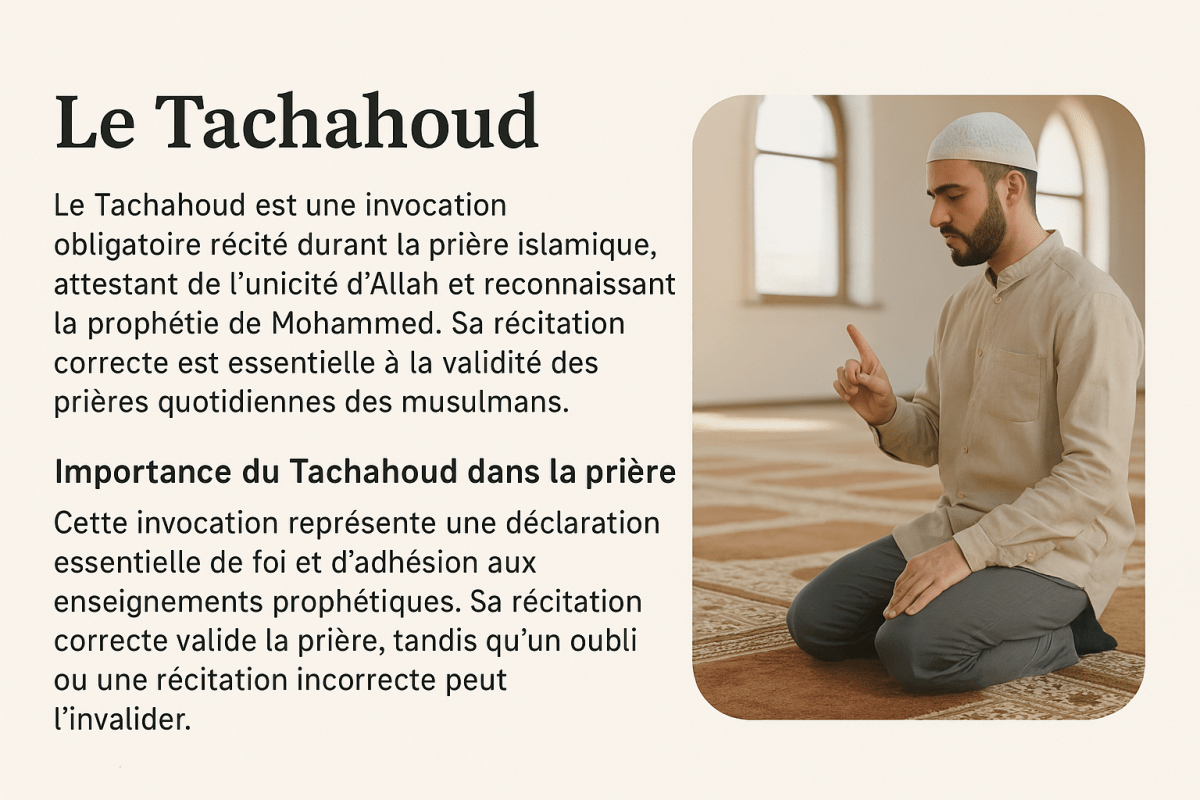
The التشهد (Tachahoud) is a mandatory invocation recited during Islamic prayer, attesting to the oneness of Allah and acknowledging the prophethood of Muhammad ﷺ. Its correct recitation is essential to the validity of the daily prayers of Muslims. Each believer pronounces this sacred formula in a sitting position (الجلوس, al-julus), raising the index finger as a sign of attesting faith (الشهادة, ash-shahada). The Tachahoud is a pillar (ركن, rukn) of prayer according to the majority of scholars, and mastering it is part of the foundations of worship in Islam.
In brief: The Tachahoud in prayer
- The التشهد (Tachahoud) is a mandatory invocation recited in a sitting position during prayer.
- It comprises the attestation of faith (الشهادة) and the salutation upon the Prophet ﷺ.
- It is recited after the 2nd rak'ah (Intermediate Tachahoud) and at the last rak'ah (Final Tachahoud).
- Several authentic formulas exist: that of Ibn Mas'ud, Umar Ibn Al-Khattab, and Ibn Abbas.
- The position of the index finger varies according to the legal schools (المذاهب, al-madhahib).
Table of Contents
- What is the Tachahoud?
- Importance of the Tachahoud in prayer
- When is the Tachahoud recited?
- Recognized formulas of the Tachahoud
- How to correctly perform the Tachahoud?
- The Tachahoud according to the four legal schools
- The Ibrahimiyya prayer after the Tachahoud
- Common mistakes to avoid
- Why learning Arabic is useful
- Teaching the Tachahoud to children
- Frequently asked questions
1. What is Tachahoud?
Tachahoud (التشهد, at-tashahud) is a central invocation of Muslim prayer (الصلاة, as-salat), during which the believer affirms the oneness of Allah (التوحيد, at-tawhid) and acknowledges Muhammad ﷺ as His messenger. The term comes from the Arabic root شَهِدَ (shahida), meaning "to testify," because this invocation contains the double testimony of faith (الشهادتان, ash-shahadatan): أشهد أن لا إله إلا الله وأشهد أن محمداً عبده ورسوله.
This formula is also called التحيات (at-tahiyyat, "the greetings"), as it begins with the words التحيات لله ("Greetings are for Allah"). Tachahoud constitutes a pillar (ركن, rukn) of prayer according to the Hanbali and Shafi'i schools, and an obligation (واجب, wajib) according to the Hanafi school. Its intentional omission invalidates the prayer according to the majority of scholars.

The Description of the Prophet's Prayer, from Takbir to Taslim
This book details each stage of the prophetic prayer, including the exact formula of Tachahoud, the sitting position, and the movement of the index finger. A reference work for mastering the prayer from the initial Takbir to the final Taslim, in accordance with the authentic Sunnah.

2. Importance of Tashahhud in Prayer
The Tashahhud holds a fundamental place in Islamic prayer. This invocation represents an essential declaration of faith (إيمان, iman) and adherence to prophetic teachings. Its correct recitation validates the prayer, while an omission or incorrect recitation can invalidate it, sometimes requiring the prostration of compensation (سجود السهو, sujud as-sahw).
The Prophet ﷺ said: "When one of you sits for the Tashahhud, let him say: At-tahiyyatu lillahi..." (reported by al-Bukhari and Muslim). This hadith shows that the Prophet ﷺ taught this formula with as much care as he taught the surahs of the Quran. Ibn Mas'ud reports: "The Messenger of Allah ﷺ taught us the Tashahhud as he taught us a surah of the Quran, holding our hands."
The Tashahhud is also a moment of intimate connection with Allah. By reciting السلام عليك أيها النبي ("peace be upon you, O Prophet"), the believer greets the Prophet ﷺ, then all of Allah's righteous servants. It is also the moment when the believer pronounces the الشهادة (shahada), the profession of faith which is the first pillar of Islam.

The Complete Prayer Guide (with Illustrations)
An illustrated guide covering all the positions and invocations of prayer, including the Tashahhud. Clear diagrams show the sitting position, hand placement and index finger movement. Ideal for beginners as well as those wishing to perfect their practice.
3. When is the Tashahud Recited?
The Tashahud is recited at specific moments during the obligatory prayers (الصلوات المفروضة, as-salawat al-mafrudha). Two types of Tashahud are distinguished:
The intermediate Tashahud (التشهد الأوسط, at-tashahud al-awsat): it is recited at the end of the second unit (ركعة, rak'a) in prayers of three or four units. It comprises only the formula of التحيات (at-tahiyyat) without the prayer upon the Prophet. After this Tashahud, the worshipper stands up for the third rak'a.
The final Tashahud (التشهد الأخير, at-tashahud al-akhir): it is recited at the end of the last unit of each prayer. It comprises the formula of Tahiyyat followed by the Ibrahimiyyah prayer (الصلاة الإبراهيمية), then the invocations of protection before the Taslim (التسليم).
Here is the detail according to each prayer:
- Fajr Prayer (الفجر, 2 rak'at): only one Tashahud (final) after the 2nd rak'a.
- Dhuhr Prayer (الظهر, 4 rak'at): intermediate Tashahud after the 2nd rak'a + final Tashahud after the 4th.
- Asr Prayer (العصر, 4 rak'at): intermediate Tashahud after the 2nd rak'a + final Tashahud after the 4th.
- Maghreb Prayer (المغرب, 3 rak'at): intermediate Tashahud after the 2nd rak'a + final Tashahud after the 3rd.
- Isha Prayer (العشاء, 4 rak'at): intermediate Tashahud after the 2nd rak'a + final Tashahud after the 4th.

The Summary of the Prophet's Prayer (with illustrations)
By Imam al-Albani, this illustrated summary presents in a concise manner the exact moments of the Tashahud in each prayer, with authentic formulas and the correct position. A practical booklet based on authentic hadith, ideal to keep in one's prayer mat.
4. Recognized formulas of the Tashahhud
Several authentic formulas of the Tashahhud are reported in the Sunnah. Scholars agree on their validity, and it is recommended to vary between them in order to follow the entire prophetic Sunnah.
Formula of Ibn Mas'ud (رضي الله عنه)
This is the most widespread formula and the one preferred by the Hanafi and Hanbali schools. It is reported by al-Bukhari and Muslim:
التَّحِيَّاتُ لِلَّهِ وَالصَّلَوَاتُ وَالطَّيِّبَاتُ، السَّلاَمُ عَلَيْكَ أَيُّهَا النَّبِيُّ وَرَحْمَةُ اللَّهِ وَبَرَكَاتُهُ، السَّلاَمُ عَلَيْنَا وَعَلَى عِبَادِ اللَّهِ الصَّالِحِينَ، أَشْهَدُ أَنْ لاَ إِلَهَ إِلاَّ اللَّهُ وَأَشْهَدُ أَنَّ مُحَمَّداً عَبْدُهُ وَرَسُولُهُ
"At-tahiyyatu lillahi was-salawatu wat-tayyibat. As-salamu 'alayka ayyuhan-nabiyyu wa rahmatullahi wa barakatuh. As-salamu 'alayna wa 'ala 'ibadillahis-salihin. Ash-hadu an la ilaha illallah wa ash-hadu anna Muhammadan 'abduhu wa rasuluh."
Translation: "All greetings are for Allah, as well as prayers and good deeds. Peace be upon you, O Prophet, and the mercy of Allah and His blessings. Peace be upon us and upon the righteous servants of Allah. I bear witness that there is no deity worthy of worship except Allah, and I bear witness that Muhammad is His servant and His messenger."

Formula of Umar Ibn Al-Khattab (رضي الله عنه)
This formula is preferred by the Maliki school. Umar (رضي الله عنه) taught it publicly from the minbar:
التَّحِيَّاتُ لِلَّهِ، الزَّاكِيَاتُ لِلَّهِ، الطَّيِّبَاتُ الصَّلَوَاتُ لِلَّهِ، السَّلاَمُ عَلَيْكَ أَيُّهَا النَّبِيُّ وَرَحْمَةُ اللَّهِ وَبَرَكَاتُهُ، السَّلاَمُ عَلَيْنَا وَعَلَى عِبَادِ اللَّهِ الصَّالِحِينَ، أَشْهَدُ أَنْ لاَ إِلَهَ إِلاَّ اللَّهُ وَأَشْهَدُ أَنَّ مُحَمَّداً عَبْدُهُ وَرَسُولُهُ
"At-tahiyyatu lillahi, az-zakiyyatu lillahi, at-tayyibat as-salawatu lillahi. As-salamu 'alayka ayyuhan-nabiyyu wa rahmatullahi wa barakatuh. As-salamu 'alayna wa 'ala 'ibadillahis-salihin. Ash-hadu an la ilaha illallah wa ash-hadu anna Muhammadan 'abduhu wa rasuluh."
Translation: "All greetings are for Allah, purified deeds are for Allah, good prayers are for Allah. Peace be upon you, O Prophet, and the mercy of Allah and His blessings. Peace be upon us and upon the righteous servants of Allah. I bear witness that there is no deity worthy of worship except Allah, and I bear witness that Muhammad is His servant and His messenger."
These formulas allow for variation in recitation while respecting authentic prophetic teachings. The believer may use one or the other according to the school (المذهب, al-madhhab) that he follows, or alternate between them to practice the entirety of the Sunnah.

Explanation of the conditions of prayer, its pillars and its obligations
A work that clarifies the legal status of the Tashahhud among the pillars (أركان) and obligations (واجبات) of prayer. Essential for understanding the difference between what invalidates prayer and what requires a prostration of forgetfulness (سجود السهو).
5. How to Perform Tashahhud Correctly?
The position of Tashahhud requires special attention. The believer must sit correctly and position his hands precisely, in accordance with the Sunnah of the Prophet:
The sitting position (الجلوس, al-julus) : for the intermediate Tashahhud, the believer sits in الافتراش (al-iftirash): he bends his left leg beneath him and sits on it, while the right foot is upright, with the toes directed towards the Qibla. For the final Tashahhud, he adopts the position called التورك (at-tawarruk): he extends his left leg beneath his right leg and sits on the ground, with the right foot upright.
The position of the hands :
- The right hand is placed on the right knee or right thigh. The thumb and middle finger form a circle (or the thumb is placed on the middle finger), and the ring finger and little finger are folded.
- The right index finger (السبابة, as-sabbaba) is raised, pointing towards the Qibla, as a sign of testimony to the oneness of Allah (التوحيد).
- The left hand is placed flat on the left knee or left thigh, with the fingers extended and joined.
The Prophet ﷺ said: "It (the raising of the index finger) is harder for the devil than iron." (reported by Ahmad). This gesture symbolizes التوحيد (tawhid, the oneness of Allah) and helps the believer maintain his concentration (الخشوع, al-khushu') during prayer.

33 Advices to Achieve Khushu in Prayer
The الخشوع (khushu', concentration and humility) is essential during Tashahhud. This book offers 33 practical advices to maintain concentration and presence of the heart throughout the entire prayer, especially during the sitting supplications. Published by IIPH.
6. The Tashahhud according to the four schools of jurisprudence
The four schools of jurisprudence (المذاهب الأربعة, al-madhahib al-arba'a) of Sunni Islam agree on the obligation of the Tashahhud, but differ on certain details, notably the movement of the index finger and the preferred formula:
Hanafi School (المذهب الحنفي): the index finger is raised at the moment of saying لا إله ("La ilaha", there is no deity) and lowered at the moment of saying إلا الله ("illallah", except Allah). The formula of Ibn Mas'oud is preferred. The first Tashahhud is obligatory (واجب).
Maliki School (المذهب المالكي): the index finger performs a continuous movement from right to left throughout the invocation, symbolizing the rejection of everything other than Allah. The formula of Omar is preferred. The first Tashahhud is an emphasized sunna (سنة مؤكدة).
Shafi'i School (المذهب الشافعي): the index finger is raised at the moment of pronouncing إلا الله and remains still, pointed toward the Qibla. The formula of Ibn Abbas is preferred. The first Tashahhud is a pillar (ركن).
Hanbali School (المذهب الحنبلي): the index finger is raised without continuous movement, pointed toward the Qibla, and slightly moved at each invocation. The formula of Ibn Mas'oud is preferred. The first Tashahhud is obligatory (واجب).
Regardless of which school is followed, the essential is to recite the Tashahhud with sincerity and devotion. The differences between the schools are minor divergences of jurisprudence (فقه, fiqh), and all are valid.

The Book of Prayer (Fiqh as-Salat)
A reference work on the jurisprudence of prayer. It presents in detail the views of the four schools on the Tashahhud, the sitting position, the movement of the index finger, and the divergences between the schools. Essential for deepening your knowledge of فقه (fiqh).

7. The Ibrahimiyya Prayer after the Tashahhud
After the final Tashahhud, the believer recites the prayer upon the Prophet (الصلاة على النبي), also called the Ibrahimiyya prayer (الصلاة الإبراهيمية), because it mentions the Prophet Ibrahim (عليه السلام):
اللَّهُمَّ صَلِّ عَلَى مُحَمَّدٍ وَعَلَى آلِ مُحَمَّدٍ كَمَا صَلَّيْتَ عَلَى إِبْرَاهِيمَ وَعَلَى آلِ إِبْرَاهِيمَ إِنَّكَ حَمِيدٌ مَجِيدٌ، اللَّهُمَّ بَارِكْ عَلَى مُحَمَّدٍ وَعَلَى آلِ مُحَمَّدٍ كَمَا بَارَكْتَ عَلَى إِبْرَاهِيمَ وَعَلَى آلِ إِبْرَاهِيمَ إِنَّكَ حَمِيدٌ مَجِيدٌ
"Allahumma salli 'ala Muhammadin wa 'ala ali Muhammadin, kama sallayta 'ala Ibrahima wa 'ala ali Ibrahima, innaka Hamidun Majid. Allahumma barik 'ala Muhammadin wa 'ala ali Muhammadin, kama barakta 'ala Ibrahima wa 'ala ali Ibrahima, innaka Hamidun Majid."
Translation: "O Allah, send blessings upon Muhammad and upon the family of Muhammad, just as You sent blessings upon Ibrahim and upon the family of Ibrahim. You are indeed Praiseworthy and Glorious. O Allah, bless Muhammad and the family of Muhammad, just as You blessed Ibrahim and the family of Ibrahim. You are indeed Praiseworthy and Glorious."
This prayer is a pillar (ركن) of the final Tashahhud according to the Shafi'i and Hanbali schools, and a supported Sunnah according to the Hanafi and Maliki schools. After the Ibrahimiyya prayer, the believer may make supplications (دعاء, du'a) before the Taslim, such as seeking protection against the four things mentioned in the hadith: the punishment of the grave, the punishment of Hell, the trial of life and death, and the trial of the Dajjal.

The Invocation in the Qur'an and the Sunnah
This bilingual collection (French-Arabic) brings together the supplications extracted from the Quran and the Sunnah, including those to be recited after the Tashahhud and before the Taslim. A daily companion to enrich your دعاء (du'a) during and outside of prayer.
8. Common Mistakes to Avoid
Several mistakes are frequently made when reciting the Tashahhud. Knowing them makes it possible to correct them and validate your prayer :
Recitation too fast or imprecise : some believers recite the Tashahhud at great speed, without correctly articulating the Arabic words. This harms الخشوع (khushu') and can alter the meaning of the words. The Prophet ﷺ recited each invocation deliberately, marking a pause between sentences.
Wrong position of the index finger : raising both index fingers, moving the index finger in an exaggerated manner, or not raising the index finger at all. One should follow the practice of the school of jurisprudence that one follows, while remaining in moderation.
Modifying the prescribed words : adding or removing words from the Tashahhud formula. The formulas transmitted by the Prophet ﷺ must be recited as they are, without addition or omission.
Forgetting the Ibrahimiyyah prayer at the final Tashahhud : some believers end the final Tashahhud without reciting the prayer upon the Prophet, which is an important omission according to the schools that consider it a pillar.
Not distinguishing intermediate Tashahhud from final Tashahhud : at the first Tashahhud (intermediate), it is sufficient to recite the Tahiyyat. At the last one, you must add the Ibrahimiyyah prayer and the invocations of protection. Confusing the two is a common mistake among beginners.

How to Purify Your Soul Through Prayer
This work explains how each component of prayer, including the Tashahhud, purifies the believer's soul. It helps to understand the wisdom behind each gesture and word, transforming prayer into a true act of spiritual purification.
9. Why learning Arabic is useful
Mastering the Arabic language (اللغة العربية, al-lugha al-'arabiyya) allows for a deep understanding of the meaning of the invocations of Tashahhud, thereby facilitating better concentration and spiritual connection during prayer.
When the believer understands that التحيات لله means "All greetings belong to Allah" and that والصلوات والطيبات means "as well as prayers and good deeds", each word takes on a new dimension. Prayer ceases to be a mere mechanical repetition to become a conscious dialogue with the Creator.
Imam Ibn Taymiyya (رحمه الله) emphasized the importance of learning Arabic to understand the Quran and the invocations. He said: "The Arabic language is part of religion, and knowledge of it is an obligation, because understanding the Quran and the Sunnah is an obligation, and they cannot be understood except through Arabic."

Morning and Evening Remembrance from the Quran and the Sunnah
This compact booklet contains the أذكار (adhkar) of morning and evening in Arabic with translation. Ideal for complementing the invocations of Tashahhud through daily practice of dhikr outside of prayer.

10. Teaching Tashahhud to Children
Teaching Tashahhud to Muslim children is a fundamental responsibility of parents. The Prophet ﷺ said: "Command your children to pray at the age of seven." (reported by Abu Dawud). For them to pray correctly, they must learn Tashahhud from their earliest age.
Here are some practical tips for teaching Tashahhud to children:
- Start with phonetics, having them repeat phrase by phrase, with gentleness and patience.
- Use visual aids: posters with text in Arabic and translation, illustrated cards.
- Pray beside them so they can imitate you in the sitting position and the movement of the index finger.
- Explain the meaning of each phrase in simple terms, adapted to their age.
- Encourage and congratulate them on each progress, without rushing them.

Making Our Children Love Prayer
A pedagogical guide that helps parents transmit the love of prayer to their children, with concrete methods for teaching Tashahhud and the other components of prayer in a positive and benevolent manner.

The Fortress of the Little Muslim
A collection of supplications illustrated specifically designed for Muslim children. In French, Arabic and phonetics, it allows the youngest to memorize Tashahhud and all the supplications of prayer thanks to attractive illustrations and an adapted format.

The Fortress of the Muslim
The essential classic of Muslim supplications. This booklet contains Tashahhud, the Ibrahimiyya prayer, the supplications before Taslim, and much more. Practical pocket format in Arabic, French and phonetics. An indispensable companion for every Muslim.
11. Frequently Asked Questions
Is the Tashahhud obligatory in every prayer?
Yes, the Tashahhud is obligatory in all obligatory prayers (الصلوات المفروضة). The final Tashahhud is considered a pillar (ركن) by the majority of scholars, while the intermediate Tashahhud is a pillar according to some and an obligation (واجب) according to others. It is also recommended in supererogatory prayers (النوافل, an-nawafil) such as Duha prayer, the Rawatib, and the night prayer.
What should one do if the intermediate Tashahhud is forgotten?
If the worshipper forgets the intermediate Tashahhud and rises for the third rak'ah, they should not return to the sitting position once they have fully stood up. They continue their prayer normally, then perform two prostrations of correction (سجود السهو, sujud as-sahw) before the Taslim (according to the majority opinion) or after the Taslim (according to the Maliki school). If the worshipper is not yet completely upright, they may return to the sitting position for the Tashahhud.
Can one recite the Tashahhud in French?
Scholars agree that the Tashahhud must be recited in Arabic (العربية). However, for the new convert or beginner who does not yet master Arabic pronunciation, some scholars (notably in the Hanafi school) temporarily allow recitation in one's own language, on the condition of learning the Arabic version as soon as possible. The effort to learn Arabic is therefore strongly recommended for every Muslim.
What is the difference between the Tashahhud and the Shahada?
The الشهادة (Shahada) is the Islamic profession of faith: "I bear witness that there is no deity worthy of worship except Allah and that Muhammad is His messenger." The التشهد (Tashahhud) is a longer invocation recited during prayer, which contains the Shahada but also greetings (التحيات), peace upon the Prophet and upon the righteous servants. In other words, the Shahada is included in the Tashahhud, but the Tashahhud is more complete than the Shahada alone.
Should one move the index finger throughout the entire Tashahhud?
The movement of the index finger (السبابة) varies according to the school of jurisprudence followed. The Maliki school recommends continuous movement. The Shafi'i and Hanbali schools recommend raising the index finger and keeping it still or slightly moving it. The Hanafi school raises the index finger at a specific moment then lowers it. All these practices are based on authentic hadiths, and the worshipper may follow the opinion of the school they follow. The essential thing is to raise the index finger in the direction of the Qibla.
What invocations can one recite after the final Tashahhud?
After the final Tashahhud and the Ibrahimi prayer, the worshipper can make invocations (دعاء) before the Taslim. The Prophet ﷺ particularly recommended asking for protection against four things: the punishment of the grave (عذاب القبر), the punishment of Hell (عذاب جهنم), the trial of life and death (فتنة المحيا والممات), and the evil of the trial of the False Messiah (فتنة المسيح الدجال). The worshipper can also make any invocation of their choice for their personal needs.
Key points to remember about the Tashahhud
- The التشهد (Tashahhud) is a pillar of prayer, containing the attestation of faith and greetings to Allah and the Prophet ﷺ.
- It is recited in a sitting position (الجلوس), with the index finger raised toward the Qibla as a sign of Tawhid.
- We distinguish the intermediate Tashahhud (after the 2nd rak'ah) from the final Tashahhud (last rak'ah), the latter being followed by the Ibrahimi prayer.
- Several authentic formulas exist (Ibn Mas'ud, Umar, Ibn Abbas), all valid according to the Sunnah.
- The four schools of jurisprudence (المذاهب) differ on the movement of the index finger but agree on the obligation of the Tashahhud.
- In case of forgetting the intermediate Tashahhud, one performs the prostration of correction (سجود السهو).
- Learning Arabic helps understand the deep meaning of the words of the Tashahhud and achieve khushu'.
- Teaching the Tashahhud to children from a young age is an educational priority for Muslim parents.
📚 Also read
−5 % off the entire library with code BLOG5
Valid on the entire site, with no minimum purchase — our thanks to blog readers.
Discover the selection


